
Scotland already operates a regulated framework for letting agents, requiring registration, qualifications, and adherence to a statutory Code of Practice.
These new rules reinforce the expectation that agents act fairly, transparently and professionally. Failure to comply not only risks legal penalties but also reputational damage and regulatory consequences.
What is changing?
The new rules take effect on 1 May 2026 in England and Scotland (they will also apply in Wales from 1 June 2026).
The law includes both direct and indirect discrimination. Explicit practices such as “No DSS” adverts are banned, but so are more subtle approaches, such as imposing stricter financial requirements on certain applicants that are not applied to others.
The legislation applies widely across the rental journey. Agents must not take steps that would disadvantage these groups when they:
- Enquire about a property
- Access information
- Arrange or attend viewings
- Enter into a tenancy agreement
Importantly, in Scotland, the rules apply to all tenancy types and have retrospective effect, meaning they cover agreements entered before and after 1 May 2026.
Scottish Ministers also have the power to extend these protections to additional groups in future.
Enforcement and penalties
Non-compliance is a criminal offence in Scotland. Enforcement will be led by local authorities, with Police Scotland and the Procurator Fiscal responsible for investigation and prosecution.
Agents and landlords found guilty can face a fine of up to £1,000.

Owners and managers still have the final say
Agents and landlords can ultimately still decide who rents a property, but decisions must be based on affordability and suitability, not personal circumstances such as family status or receipt of benefits.
Standard referencing checks remain permitted, and agents can still request guarantors, rent in advance (once the tenancy is agreed) and apply financial criteria so long as they are consistent across all applicants.
There are limited exceptions. For example, refusing children may be lawful if it is a proportionate way to avoid statutory overcrowding. However, no equivalent exemption exists for benefit claimants.

Contracts, mortgages, and insurance
The legislation overrides existing restrictions that could previously lead to discrimination.
Any clauses in mortgages, superior landlord agreements, or new insurance contracts that prevent letting to tenants with children or on benefits will have no legal effect.
Existing insurance policies with such restrictions are temporarily exempt, but only until they are renewed.

Support for members to prepare
Agents should review:
- Property adverts and marketing language
- Application and referencing processes
- Affordability criteria to ensure consistency
- Internal policies and staff training
Any practice that could discourage or disadvantage applicants with children or those who are on benefits must be removed.
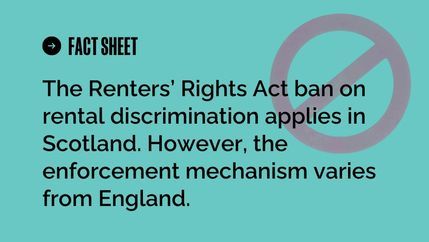
Propertymark has produced a fact sheet specifically for lettings members working in Scotland, which breaks down the legislation and how to comply.
Our Scottish National Conference takes place on 26 March, featuring updates from property economist, chartered surveyor and Director of Research & Strategy at Rettie, John Boyle, commercial and property litigator Rory Cowan, and Propertymark's head of policy and Campaigns, Timothy Douglas.
Delegates can also pick up a printed copy of the rental discrimination fact sheet at the event.